


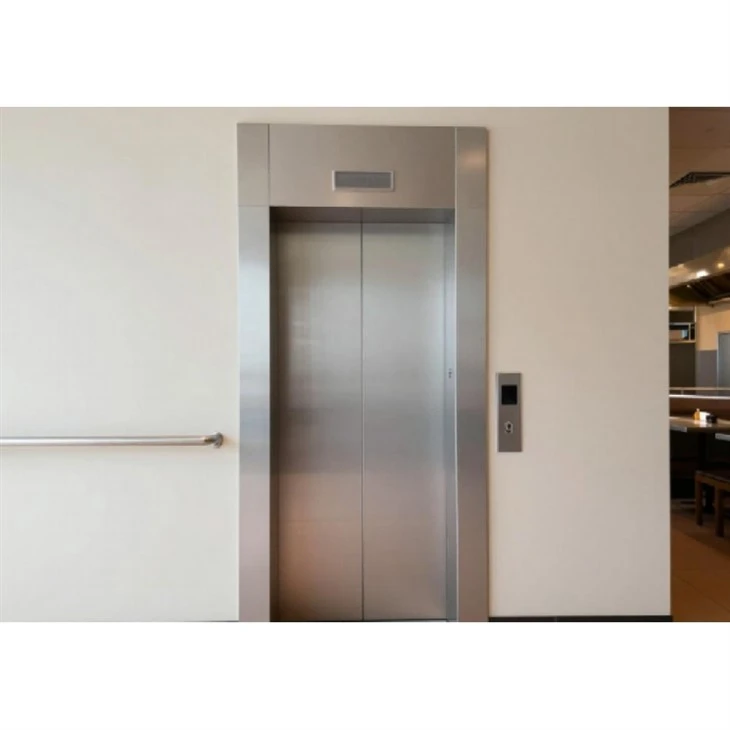
Restaurant Dumbwaiter Elevator | Technical Specification & Sourcing Guide
A restaurant dumbwaiter is a specialized vertical lift engineered to transport food trays, dishes, beverages, and supplies between floors. grandfujielevator units feature food-safe interiors, dedicated interlocks, and compact footprints tailored for tight building shafts.
Standard Capacity: 50 kg to 300 kg (custom up to 500 kg)
Operating Speed: 0.25 m/s to 0.4 m/s
Car Construction: Food-grade SUS 304 stainless steel, argon-arc welded with hairline finish
Drive Mechanism: Traction machine (gearless/geared) or Hydraulic cylinder
Key Features & Advantages
SUS 304 Stainless Steel Cabin: Withstands chemical cleaning agents, food acids, and high commercial kitchen humidity.
PLC Microprocessor Control: Manages floor leveling accuracy within ±3 mm, door interlocking, and built-in fault diagnostics.
Mechanical-Electrical Door Interlocks: Prevents door unlatching unless the car has stopped at the active landing, eliminating fall hazards.
Modular Steel Frame: Self-supporting structural steel guide rail towers eliminate the need for reinforced concrete load-bearing walls.
Technical Specifications
|
Technical Parameter |
Standard Specification |
Options / Customization |
|
Rated Load |
100 kg / 200 kg |
50 kg – 300 kg |
|
Rated Speed |
0.3 m/s |
0.2 m/s – 0.4 m/s |
|
Max Travel Height |
30 meters (up to 6 stops) |
Extended travel upon engineering review |
|
Car Dimensions |
800 × 800 × 900 mm |
Custom engineered to shaft limits |
|
Power Supply |
380V / 50Hz / 3-Phase |
220V / 440V / 480V (Single/Three-Phase) |
|
Drive Motor Power |
1.1 kW – 2.2 kW |
Variable frequency drive (VVF) |
|
Door Type |
Vertical Bi-parting |
Single hinged, manual or automatic |
|
Guide Rail |
Precision cold-drawn T-rail (T50 / T70) |
Machined solid steel rails |
Operating Principle
Call/Send Execution: Operators press landing buttons equipped with LED status indicators.
Interlock Verification: Safety circuits confirm all hoistway doors are securely locked.
Drive Activation: Traction winch or hydraulic pump initiates car movement via suspension wire ropes or direct plunger.
Precision Leveling: VVF closed-loop drive decelerates the car as it approaches the destination, engaging a mechanical brake for exact flush landing.
Hoistway & Building Requirements
Shaft Construction: Reinforced concrete, concrete block, or structural steel framework with minimum 2-hour fire-rated drywall cladding.
Pit Depth: Standard 200 mm to 500 mm pit for buffer springs and frame clearance (Floor-level models adaptable for zero pit).
Headroom Clearance: Minimum 1200 mm to 1500 mm overhead clearance above the top landing for machinery access.
Environment: Hoistway temperature range of 0°C to 40°C with local smoke ventilation compliance.
Drive System & Core Components
Traction Machine: Worm-gear or Permanent Magnet Synchronous Motor (PMSM) top-mounted in the hoistway; acoustic emissions < 60 dB.
Suspension Ropes: High-tensile galvanized steel wire ropes (8×19S+FC construction) with a safety factor > 10:1.
Control Panel: Industrial-grade PLC relays, contactors, and terminal blocks.
Buffer System: Polyurethane or spring-loaded mechanical buffers at the pit floor.
Safety & Emergency Systems
Overspeed Governor: Mechanical safety clamps trip onto guide rails if descent speed exceeds rated limits by 115%.
Phase Protection: Relay monitors incoming voltage against phase loss, phase reversal, and surges.
Emergency Lowering: Mechanical manual release lever allows gravity-assisted lowering to the nearest floor during power failures.
Overload Sensor: Electronic load cell halts movement and triggers an alarm if cargo exceeds 110% capacity.
Standards & Compliance
Grandfujielevator manufacturing processes conform to:
ASME A17.1 / CSA B44: North American elevator safety code.
EN 81-3 / EN 81-40: European safety standards for dumbwaiters.
ISO 9001: Certified quality management for raw material inspection, welding, and load testing.
CE & UL: Certified electrical components and control panels.
Configuration & Customization
Loading Layouts:
Access Openings: Single-side, through-loading (opposite), or 90° adjacent configuration.
Shelving: Removable or fixed SUS 304 intermediate shelves for thermal separation.
Applications
Restaurants & Bars: Move dishes between multi-level kitchens and dining areas.
Hotels & Banquet Halls: Transfer room service trays and tableware.
Hospitals & Nursing Homes: Transport dietary meal carts between central kitchens and ward pantries.
Bakeries & Cafes: Move baking trays between production levels and display counters.
OEM / ODM & Project Support
Shop Drawings: AutoCAD and Revit (BIM) submittal drawings provided within 48 hours of parameter receipt.
Factory Testing: 4-hour full-load test run conducted prior to crating.
Export Packaging: Fumigation-free plywood crates for ocean freight container transit.
Technical Support: English installation manuals, wiring diagrams, and remote video support.
FAQ
Q: Floor-level loading vs. counter-height loading?
A: Floor-level units align flush with the building floor for rolling utility carts. Counter-height units elevate the car to ~900 mm for ergonomic waist-height tray loading.
Q: What electrical power is required on-site?
A: Standard units utilize 380V / 50Hz / 3-Phase. North American or custom regional variations (220V, 440V–480V 3-Phase) are supported. Control circuits run on safe 24V DC.
Q: Can this be installed without an existing elevator shaft?
A: Yes. We provide self-supporting structural steel towers installable inside open stairwells or floor cutouts, requiring only post-structure fire-rated cladding.
Q: How is food sanitation maintained?
A: Interiors, shelving, and doors use brushed SUS 304 stainless steel, preventing bacterial buildup and resisting food acids and sanitizing chemicals.
Q: What prevents movement while a door is open?
A: Landing doors feature mechanical-electrical interlock switches. The motor will not execute travel unless all doors are fully locked; opening any door triggers an immediate emergency stop.
Hot Tags: restaurant dumbwaiter elevator, China restaurant dumbwaiter elevator


